Strong ratings don’t always translate into enough advertising revenue to fund independent TV programming. Just ask Rob Rose, producer and host of Raw Travel.
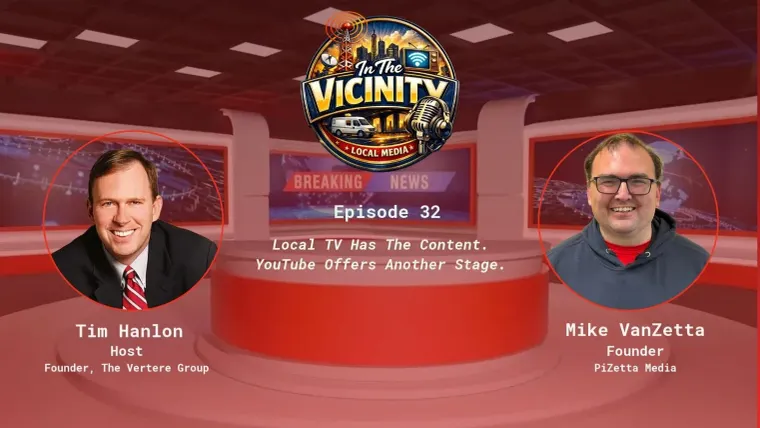
In Episode 33 of In The Vicinity, Rose joins Tim Hanlon to discuss:
- The economics of TV syndication.
- How station consolidation affects independent producers.
- Why FAST channels haven’t filled the revenue gap.
Listen to the full In the Vicinity podcast above or get it on Apple Podcasts and Spotify.
Tim Hanlon: You're In the Vicinity. Welcome. My name is Tim Hanlon the founder and the CEO of the Vertere Group here in Chicago, where we do our best to consultatively advise and help out various companies in and around the media and technology landscapes. Some of those are large, some of those are small, some of those are very much in between.
But regardless, here to help. This is our little weekly sojourn into as many things as we can think of in and around local media, some of them obvious, and frankly, a lot more of them not so obvious. And I thought I would go deep on that end of the spectrum this week with our guest, Rob Rose, to talk about his long-standing syndicated TV show.
It's called Raw Travel. You may see it in and around your local television listings mostly on the weekends. It's available pretty much all across the country, I think 97, 98 percent of the country. Three hundred plus stations over 187 cities, markets around the country.
You'll find this half-hour travel show on your television sets. It's an amazing story. Rob has been around the television production space for quite some time, and has some amazing origin story memories to get us going. And then in the midst of all of that, you will hear what it takes to create. distribute, and sell against a largely independently oriented syndicated television property.
A more difficult proposition by the month it seems, as local television becomes more consolidated, the syndication business becomes more compromised, challenged by streaming and all that kind of stuff. But Rob has been at it for quite some time. Raw Travel started in, I think it was 2013.
It's now in the midst of its 14th season, I believe, something along those lines. And as you'll hear in our conversation coming up, perhaps one of its, if not the best performing seasons of its lifetime. But that's not without twists and turns and challenges. And I thought this would be a great conversation to shine a light on where broadcast television syndication kind of sits through the eyes of somebody who's lived it for some time and probably the most challenging path to be successful in it as an independent in that space.
So here is me and Rob having a fascinating conversation. And again the show is called Raw Travel. You can find out more about it and where, what stations, and when it's running at rawtravel.tv. But give a listen to our chat first, and sit back and please, as always, enjoy.
I kinda wanted to double-click a little into the world of local TV programming and syndication. I think a lot of people know it in sort of historical terms, the old NATPE and conventions and all that kind of stuff. But things have, of course, like a lot of things in this business, have changed, and I thought maybe it would be interesting to hear from somebody who is, as an independent still playing that game, whatever that game is, because I think your viewpoint's probably more unique than most.
Tell us about your background, though. How did you even get into this crazy business of television production and syndication and stuff?
Rob Rose: Yeah, so I came up on the ad sales side of the business in Nashville, where I'm from, and I sold newspapers initially out of college and then radio. But I got into TV pretty early in my career at the local Fox affiliate, and this was the mid to late '90s, so they had just picked up the NFL.
We were selling The Simpsons.
Tim Hanlon: What station was this, and who owned it?
Rob Rose: It was WZTV, and it was Act 3, which was owned by Norman Lear at the time. So that was a unique thing because it wasn't very corporate, but then we got bought by Sullivan Broadcasting, which eventually became Sinclair.
And I still keep in touch with the station because I go home and visit my family in Nashville even though I'm in New York, and the current show that I produce, Raw Travel, airs there. So I keep up with it and I do business with Sinclair. But I left Nashville in '96 to move to New York just as a lifestyle choice as a young man, making his way in the world, and ended up at Univision, Spanish language TV, and they had just gone public and were hiring people for the first time. Owned by Parentio, and he was a boxing promoter, I think, at one time. And basically I was part of the general market people that they had hired to change that business. And those three years that I spent there, I only spent three years, were incredible.
They just flipped my world upside down. Not only was I living in New York City, I was working in corporate America for the first time. I was learning about the Spanish language world, trying to learn Spanish. Before that, I think I felt Puerto Rico was off the coast of Africa. I was pretty dumb geographically and in a lot of ways, and but the most important thing I learned was using research to sell, and it was interesting that while I was there I saw research that spurred me to go out on my own and do my own business to compete with Univision, and it was the fact that they were reaching this first generation Latin market but two-thirds of the Latin market was second or third generation, and they really didn't have anything for them.
This was of course pre-YouTube and TikTok and all that. So we created a Latin TV show in English. And, obviously you're not gonna go network. The best way to do it was syndication, because then you could focus on the high Hispanic percentage of the markets.
And I think we started in 30 markets, but that those 30 markets were, like, 96% of Hispanic homes. So it was done with what we knew.
Tim Hanlon: Who is we at this point? This is you after Univision doing this?
Rob Rose: Yeah, so at Univision I met a producer, a promotions producer, who had an idea. He's a young American Latino himself, second generation whom I still work with.
And so Renzo Devia is his name, and he had produced an idea for a TV show that was just simple. It was just a Latin TV show, but in English with Latin celebrities, and they're basically trying to show the non-stereotypical side of Latin life. And we called it American Latino.
And we started our own company, and it worked. We got major sponsors. And because I was from Univision but was telling a different story than Univision, I got into C-level marketing suites at McDonald's, Volkswagen, General Motors. I was meeting with the crème de la crème, and was considered an expert simply because I said the research that no one else was talking about.
No one wanted to talk about it because they didn't wanna kill the goose that laid the golden egg, which was Spanish language TV. But young Latinos really responded. And I did that for nine years. We did it really successfully, and then I got offered…
Tim Hanlon: Before you go further, where did you find success in placing this show? What types of stations? This kind of gets into last vestiges of the traditional syndicated TV business model in the United States as things have changed. Where did you get this show picked up? What types of stations were the ones most interested?
Rob Rose: So these were the days when NATPE was in New Orleans, and you had 20,000 people going, and it was a big deal, Wheel of Fortune and Jeopardy! and Oprah and all that was on the air. And it was a big deal, right? And we couldn't even afford a booth, so we were as guerrilla as could be, which I liked, but at the end of the day, that's the environment, the media environment we're talking about. We started off as a local cable show. I skipped that part. I did that because that was the only money we could get, and Cablevision financed 13 episodes, and I made a deal with Cablevision.
I wanna syndicate this, and if I do, I'll cut you in on the first 13 episodes that you finance. And when I did and I brought them a check, they were shocked. They couldn't believe that I had done it. But how did I do it? I went to LA, New York, and Miami, and the New York clearance, of course, is always and has always been key to my career.
Whenever that falls into place, everything else fell into place. And for some reason, New York has been very good to me, Tim. That's why I'm a big defender of New York. Always the people here, for whatever reason respond well to me, to this guy from Tennessee. And basically, at the end of the day we were able to get it, like I said, in about 27 markets.
Of course, you had to get Texas, all the high Hispanic markets. It was a pretty easy sell. And because they were…
Tim Hanlon: Independent stations?
Rob Rose: No. CBS, ABC, NBC. Fringe time periods, weekend, half-hour, but in LA, we were on KABC, Sundays at 4:30 p.m. or something crazy. We got some really good time slots.
New York, I think it was CBS Saturday, Sunday at midnight. 5:00 in the morning at other places.
Tim Hanlon: How did you achieve that, though, being such a small fry without a booth?
Rob Rose: I went and visited, and I took whatever savings I had because I also had to reformat the episodes that we had produced locally for a national audience.
So I basically depleted my savings and that was something that I will always remember because that was very uncomfortable. And basically, we're talking about maybe 50 grand. And I just traveled from place to place as cheaply as possible. I remember someone distinctly seeing my rental car, and it was a little smart car kind of thing, and they were laughing.
And I was like, "Don't laugh, man. I'm trying to make this happen." And dude I'm not gonna lie, I cried. I was so busy. I was so stressed out. I couldn't feel my right arm. And this was all because I was doing something I didn't wanna do, which was be an entrepreneur. But the research was so overwhelming that I felt like I had no choice. Because I knew that the big companies wouldn't see what I saw and do what I did, and I just felt it's now or never. I was 33, and so I did it. And like I said, we got on the air, but then the thing about syndication is nobody's paying you to get on the air. It's a barter syndication. At least that's what we were.
Tim Hanlon: Describe that for those who don't know what barter is.
Rob Rose: So barter is basically you give your show to the TV station, and they give you a time slot, and you split the advertising time. They sell their portion of the advertising locally, and you string together all your markets and sell it in the national marketplace, which I had only sold local up until then.
Even at Univision, I sold locally. Now, I didn't mention that to a lot of people, because I wanted them to hear Univision and do that, and it got me in a lot of doors. But what I found is you just add another zero to it. There's no mystery to national versus local. If anything, it's easier. And we were running at a deficit.
I was putting everything on my credit cards. I had spent all my money. I'd convinced people to work on deferred, and basically was pretty sure I was gonna go bankrupt and have to go live in Tennessee with my parents again. And I remember having one meeting with Anheuser-Busch. This was back before they became corporate, when they were a family company, and showed them the presentation, and they clicked.
They got it, and I knew that we were gonna be okay. And, I won't get into the details, but their check came in a week before I was gonna run out of money, because they paid zero to 60 instead of zero to 90 like everyone else. And everything just worked out. After that, I got Volkswagen, McDonald's.
We built a little company. We had maybe 20 people, but we were still small, independent. But those nine years that I did that was intense, I just traveled the country, mostly ad sales. I was an executive producer and distribution, and I would even hire people to help me distribute at some point.
And I think we ended up in 80-something markets. Did that for nine years, but that was the heyday of syndication. I didn't know it at the time. We were making big money compared to what would come later.
Tim Hanlon: Okay. What years are this? Is this the heyday of the late '90s, early aughts?
Rob Rose: No, I'd say the early aughts to 2009, right before the financial crash, is when I sold it. So it made me look like a genius, because I did get out right at the financial crash. But the new owners, LATV out of Los Angeles did quite well with the show, and I think it aired until 2016.
American Latino and Latin Nation we ended up doing a spinoff show as well. And I took the opportunity to go travel, and I went to live in Colombia, live abroad, and just travel and backpack Latin America, and try to decompress from this nine-year experience that I'd had. And for the first time basically I was living like a college student on a gap year at the age of 40. And when I was traveling in Colombia, I got bored, as you do when you travel and you're finally decompressed. And so my producer, Renzo, a Colombian American, was also down there decompressing, and we just decided, "Hey, let's do a travel show."
And we're like, "Okay, what's the idea?" And I'm like what I saw in the U.S. wasn't matching my experience of travel." U.S. travel shows expressed more of either a food celebrity thing or wealthy fantasy travel, I call it. I wanted to do travel that people could actually do that kind of matched what I was doing, like living abroad, staying in hostels, boutique hotels, having local experiences with locals, doing some give back.
And so we called it Raw Travel. And because I wanted to keep it real and honest and authentic, I hosted it thinking I won't put my name on it because I might not be the host, because I've never done this before. And ended up liking it. And anyway, we got it on the air three years later after we first shot the show, when I had moved back to the U.S., back to LA at the time.
And this time, the world had changed. Syndication was completely changed.
Tim Hanlon: And what were some of those changes, right? Because in that timeframe you're talking about, lots is going on in the media, but also syndication and syndicated TV. Can you describe some of those visceral changes that met you as you were trying to maybe now figure out how to monetize this new project?
Rob Rose: First of all, a lot of the people I had done business with were no longer in the business. It was like the first wave of consolidation, layoffs, et cetera, from the financial collapse, crisis. The Great Recession. Secondarily reality TV had hit that scourge that I think we're still living with today, the repercussions of.
I didn't want to syndicate the show, because I knew how hard it was. I wanted to go to cable, like a travel channel, and just have someone finance it and let me do my thing, be creative. A luxury that perhaps, I've never earned. I have to, or I have to earn it, right?
And I went to Travel Channel, and they were like, "Oh, you're too earnest, and this is too blah, blah, blah." And they were right. But they wanted me to be over the top like a Duck Dynasty guy and have a long beard and be crazy and wild on camera, and that's just not me. And I'm like, this is about authentic and real travel."
And they weren't into authentic and real travel, and they were switching to I think haunted houses at the time, which is what they currently do. So because Travel Channel kind of left that void, and there weren't really any good shows other than Anthony Bourdain, which he had just moved to CNN. There really wasn't much out there. And so Raw Travel, I still didn't wanna syndicate it, Tim, because I knew it was work. So I'll tell you how it worked. I came from LA to New York to see some friends. I had a pilot episode and I don't think I'm speaking out of school when I mention names here, but Lew Leone at Fox 5 and Dan Carlin at Fox 5, I'd known from my American Latino days.
They had been my affiliate. And I requested a meeting just to catch up with them. And they were like, "What have you been up to? We haven't heard from you in three years." I'm like, "Oh, yeah, check this out. I got this show." And they were like, "You know what? We like that show. That would be good for this new sports show we picked up in late fringe."
And I'm thinking to myself, "Wait a minute. I'm not even syndicating this. I only have eight episodes," but I knew that once you get a New York clearance, you're almost obligated to run with it. So I left that meeting both exhilarated, because I had unexpectedly run into a New York clearance, and also depressed, because I knew what was ahead of me to get it out there on a national stage.
Tim Hanlon: And how did you change your dynamic when you, if you will, were now forced back into the syndication model to do this?
Because it seems like the economics of the industry had changed, and certainly the conferences where these shows are sold were certainly going sideways.
Rob Rose: Yeah, but in a way NATPE was still going on, but it was in Miami now at the Fontainebleau, and much smaller.
Tim Hanlon: A shell of its former self.
Rob Rose: A shell, right. But in some ways it was easier. Harder but easier. Harder because I'm no longer niche. I need to get at least 70% of the entire United States. Hispanic doesn't matter anymore. That's a much bigger footprint but easier because of consolidation, now I can meet with fewer people to get bigger deals, multi-market deals.
But it still wasn't easy. So when I went to NATPE in the spring of January of 2013 from California, I took a carry-on bag that had two wardrobes, one for Miami and one for Boston, because there was a blizzard in Boston. For three months, I did not see my bed in California. My parents let me stay in my Tennessee home, but I went market to market.
I did it old school, man, station by station. Because even with the groups, for weekends, a lot of program directors and general managers have a lot of say. And, especially in the big markets, you really need to have a personal connection. You did at the time, and that's what I did. And again, I was hating myself.
I was like, "What have I gotten myself into? I didn't even have to do it." And I didn't really count on doing this, but we ended up getting it in again, like 70 or so markets in year one or 70% of the country. And again, the ad sales. Now I don't have those contacts because my contacts were in the Hispanic ad world.
So I'm trying to get meetings with American Airlines and travel companies, and I got a couple but they didn't understand the concept of syndication. And then I got an offer from a company that I still work with today that they'll sell the unsold ad time for direct response.
That to me was a license for bankruptcy because direct response when I was working in it in 2001 to 2009 meant that you were just getting really low rates. Filler, right? And that wouldn't get it done. But the gentleman I worked with was able to actually get some decent rates that allowed us to at least tread water and not lose as much money.
And then that combined with my own ad sales and getting my feet up under me, after about three years I broke even finally. And remember, I had more money now to play with because I had sold my previous company. But that said, you never wanna lose money, especially when it's much bigger stakes this time.
And yeah, I didn't wanna lose it. So I pretended that was the only money I ever had, and I just kept working and our distribution kept growing and our ad sales kept growing as well. But the numbers were much smaller from an ad sales point of view than they were in my American Latino days.
Tim Hanlon: Why? Because syndication was falling out of favor as a media buy in national circles, or because the fragmentation of viewership is just declining and the stations' viewership numbers are just going down?
Rob Rose: Yeah, I think both of those combined. The fragmentation.
Also I was dealing with some headwinds in the travel industry because I was an unknown and I pitched myself as a poor man's Anthony Bourdain or an independent kind of thing. But a lot of people, they just didn't understand broadcast TV. I'm gonna name names here because it's a long time ago.
I'm gonna name, not personal names, but the Los Angeles tourism, whoever was handling their marketing in Los Angeles, I remember I had a meeting with them and I go in and I show my pitch. Part of our pitch was comparing broadcast TV to cable, and in doing so I'd compare Raw Travel to Anthony Bourdain, who was alive and on CNN at the time.
We had a bigger audience. This is year four or five. Why did we have a bigger audience? Because free, over-the-air TV was much broader than cable. They did everything but call me a liar, essentially, to which I took offense. I'm high-strung, right? And I said something to the effect of, "It's not my problem that you don't understand the difference between broadcast and cable. That doesn't make me a liar." To which they said, "Here's your validation. Get out of our office." And I was like, "Oh, God, I should have eaten." I didn't eat that day. I was cranky, and I don't like being called dishonest, especially when the research is right there. But it's emblematic of the problems I faced in trying to educate people what syndication was, because a lotta people at that point didn't even have TVs.
They were getting away. It's like a landline at that point. But I knew it was still powerful because I was getting the emails. I knew that the people that we featured on the show their travel companies were blowing up. They were begging me to come back and film some more because they were blowing up.
So how do you take that and translate that into revenue for us? And so that was really a challenge, but we ended up having some success, and a lot of it, like I could cold call somebody all day long, but if the Korea Tourism Bureau sees me on the local CBS affiliate in Los Angeles, they think I'm a CBS TV show, and they're like, oh, and then I'm famous.
And so they call me in, and I charm them, and they love me, and then next thing we're filming six times in Korea. That's kinda how we made money. But a lot of it was independent, go to the cheapest locations and spend as little money as possible because I'm financing everything.
So my film crew loved it when someone else was paying because now they're flying, maybe not first class, but not coach with multiple connections, and they're gonna eat really well and stay at a nice hotel, where if they're going with me, we're all staying in the same room. It's a very different experience.
Tim Hanlon: The show's been on for almost, what, 12 years now?
Rob Rose: 14. We're in our 14th year being on the air.
Tim Hanlon: All right. So as we cul-de-sac this and I could go on for hours, and maybe we will on another episode, too. How can I best phrase this? Did you kinda just sneak in, if you will, as the window of the traditional classic syndicated business model was closing? Because as an independent, it seems like it's gotta be harder than ever to keep the economics going, but then also the clearances and all that kinda stuff versus frankly whatever's left, which is, by the way, not much in terms of output.
Syndication has got seemingly smaller and consolidated into now just a handful of firms that kinda control all the dynamics. I can't imagine how you can succeed in that bullion base when you're still independent.
Rob Rose: Yeah very apt, Tim, because I think I did. That window of opportunity was just there. Now, had I been a little bit earlier, I might've not have. Not that I'm as talented as this guy, but Anthony Bourdain, the people that were around him, the Samantha Browns and the Anthony Zimmermans that were on during the heyday of cable, they all became semi-famous.
And I never really had that level of success in terms of personal. I can't go to a travel show and get paid tens of thousands of dollars for my appearance. But that said, from the syndication point of view, yeah. And I think it was because travel had never really explored syndication, and when it's right there on free over-the-air TV, it just worked really well, and people were surprised at that, including me.
I didn't know if it was gonna work or not, especially me as the host. But just this week I had lunch with a TV station, which in and of itself is unusual these days, because I don't travel like that anymore. No one does. And having lunch with your client rarely happens. But there's a few people I can still take to lunch, and she asked me a question, "Could you do now what you did 14 years ago?" I said, "Absolutely not, nor would I. There's no way." But because we're already on the air, that momentum carries us, and our time periods are better than ever almost, because everybody else is getting out of the business. So it's weird. I remember we went to NATPE one year right after the financial crash.
I was consulting with the new owners for American Latino. We went from not being able to have a booth to being the biggest booth, and I was like, we finally became the biggest fish in the pond, but the pond got really small. So it was like, I don't know whether to be happy or sad. And I'm kinda like that, as an independent these headwinds create opportunities. And the problem with studios is that they don't know how to do it. They can't be lean and mean, and the only reason I exist is because I was super lean and mean. It's micro-budgeted, or no-budget. We even call it no-budget in the film industry.
Until you get some money, then you start spending a little money, but you find that money doesn't always buy you success. You have to think creatively when you don't have money, and that is something for some reason studios don't seem to be able to do as well.
Tim Hanlon: So segue that into your perceptions of where you think your clients/buyers, the TV stations, the groups that you partner with, that have been on your side for, this decade plus now.
What have you seen perhaps through their eyes of what, quote unquote, "syndicated fare" looks like? Is it essentially just gonna dwindle further? Is there a renaissance perhaps, maybe where more independents come into play? There's plenty of, let's call it inventory, right? Because these stations, especially those that are forced to now run multiple hours of news and stuff, right? There's a point at which I think stations have to get more creative again, or anew to either fill in for whatever the network doesn't provide, maybe even as they walk away from network affiliations.
We haven't even talked about that, that dynamic which is fraying. Where does syndication fit? Is it basically dying out, or is it ripe for a rebirth, or, and frankly, what about your show? Where do you think the next few years go for Raw Travel?
Rob Rose: So I'm simultaneously grateful and extremely frustrated with broadcast television. I'm so grateful for the great treatment that I got and the trust from people like Lew Leone at Fox 5, where I'm walking on the street in a city with actual celebrities and I get recognized. That's insane to me. I'm like, dude, I am barely registering anything.
Yeah, but people are calling me in New York City. Yet I go to a city like Nashville, where I'm from, and nobody ever recognizes me. What's the difference? We have an extremely well-run TV station here in New York, puts us on at a really good time slot, and it just resonates with an audience that loves to travel.
Nashville, not as much. And I'm not picking on Nashville, but it's just the way it is, and it frustrates me because I'm like, "I want you guys to travel."
Tim Hanlon: To clarify, one is an owned and operated station that also has an adjunct secondary station in most markets within the My Network Television group. So there's some advantages there in terms of distribution and flexibility and stuff. The other is I think now a Sinclair station affiliate with somebody, right? Which is maybe not as voluminous in terms of the opportunities and promotional things, et cetera.
Rob Rose: They have three stations, and they have one person, and the money isn't as big, right? And it's not Sinclair's fault, it's just their business model is different than an owned and operated big market thing. And so that's, to me, the difference. That said, ZTV actually takes really good care of me, and I have a personal relationship with them.
But what would frustrate me was not that. What would frustrate me would be when stations would have a successful show, and I won't name names here, but in a major market where Raw Travel would come on after the late local news and increase ratings and share, especially among 18- to 34-year-olds, which was nonexistent in their local news. And rather than see that as an opportunity, they would end up running paid programming or something after that. And I'm like, "You do realize 18- to 34-year-olds today are gonna be tomorrow's 25 to 54s."
Rather than envisioning an opportunity, 10 years ago TV stations just focused on that. And it reminded me of my first go-around with American Latino.
Our biggest competitor was paid programming, and they would come in and be like, "Why shouldn't I just run paid?" And I'm like, "Because that's not what you get paid for. You're supposed to create a sustainable business." And then what ended up happening is paid programming drove all the people away from broadcast that first time.
The second time around there are some syndicators that don't necessarily believe like I do that that content is king. They believe that content is that stuff you run between the commercials that they need to make. And so they overload it with commercials. They run garbage content.
And what frustrates me with the local broadcasters is to not see the difference between what we're doing and trying to do versus what they're doing, which is simply disrespecting the viewers and they could care less if anybody watches. If stations don't care, why should I care? And it's really hard unless everybody cares.
And I think all the stakeholders have to win. In New York, for example, I feel like all the stakeholders are winning. The viewers are winning. The station's winning. They're selling it locally. I'm selling it nationally based off my New York clearance. I'm just using New York as an example.
Whereas in another market nobody cares. And I'm like, "If you don't care, then you don't have a business." But the corporation that owns that has created that dynamic where their employees don't care. They're just trying to get to retirement. And I think that's really sad.
Tim Hanlon: Okay. So here's my last windup then. Given that hand that you've been dealt, okay, what is the future for Raw Travel the show, and maybe more broadly, where do you think the future is for syndicated fare and quality? The one that you just described versus the junk kind of stuff that's out there?
Rob Rose: For me, Raw Travel has fulfilled its obligation, which we did 200 episodes.
We're now running our library content. And what is ironic is that we're having one of the best years we've ever had. We're up 30%. We're having years pre-COVID. We're having audience levels at almost pre-COVID levels. Why? Nielsen has changed their methodology. That's one. But beyond that, the stations have better time slots for us.
My research guy and I were looking at, it's a little early still, but season 14 is looking like a banner season. And I'm trying to figure that out as well. But the ad revenue is not there for me to go out and say, "Let me go produce new content." So the future for us is opportunistic. I was just in Miami at a travel conference, and if there is another Korean tourism organization relationship where we can go and get some partnerships with people to produce new content, we can do some digital first stuff.
That's just Raw Travel. For broader syndication, I think we could act as a business model for people in that boutique niche targeted, but, and I hesitate to say high quality, because I don't know if my show would qualify as that. But a dollar works really hard on Raw Travel, whereas some people, you can tell they didn't spend any money, time, or effort.
And so we put every effort. It could've been good or bad or whatever, but I was like, make it unique. Make it different. It has to stand out. It has to have a brand, and the people have to care. And that really comes through. People really know that. I think our viewers know that.
Just having your updated clearance list. Where are you running every week? I actually pay people just so that our website is updated every week. It's not always 100% accurate, because things change. But just that caring boutique mentality. And I think studios can do that, because they did it in film.
Sony Pictures did it for their indies. And then indies became mainstream, and now they're too heavy and too big budgeted now to make money. It's always gonna be a balance between art and commerce. And I think there is a balance there.
But, and also the diginets, another thing I won't get into, because that's not what this is about, but the diginets represented an opportunity to do something different. Instead, everybody just did Gunsmoke reruns. That's insane. You had free over-the-air TV, an audience that is price-conscious but doesn't understand that there's this free stuff out there, like the young people.
Why didn't the TVB and the NAB market that to people? Instead, they focused on more consolidation so that a few of their bigger members can make more money. But short-term it does a disservice to people who love the TV business and who worked in it their entire lives. I love the TV business, but, if one, three people own it, then it's no good.
Tim Hanlon: All right, let me ask you this one last question then, because I think you brought it up. Do you think there's maybe a value proposition that you could bring as a classically defined independent syndicated programmer into maybe helping stations and groups evolve their business model in terms of things like streaming, for example?
So the FAST channel environment. Most stations it's the news and the repeats of news. Obviously, it's not network content, they have no rights for syndication stuff, and they gotta fill that stream with more stuff. And if it's just repeats of news, it's like, “boy, that's so what and it's stale.”
Do you think maybe there's a little model or a mini model in there where the syndicator of the future could maybe be helpful in programming those off-hours on the streams, either in addition to or instead of the actual linear channel? Or am I just dreaming?
Rob Rose: No, I don't think you're dreaming, but I think the thing about TV is that it's formulaic. And everybody's looking for a formula. I don't know that there is a formula for creativity and caring and passion, and that's what you're looking for, so hire better people. There was a moment in time where ad sales people were some of the highest paid people at a station because they were out there really doing the big heavy.
And then at some point, the big stations went and ended up hiring the cheapest talent they could find, and they cut corners because they thought that was the way to profitability. And I think the opposite is true. I think if you have good talent, they're worth paying for, and I think the model is you just back into here's how much money we're making, here's how much we can afford.
What's the best show we can produce for this amount of money? And that's what you have to do as an independent producer. I only have this much money. Can I make this work? And a lot of times you don't know, because no one had ever done 20 episodes of a travel show before. Even Bourdain, he was doing 10.
That's a season on cable. I was like, "How are we gonna do 20?" And then I figured out the formula. You do more than one show when you travel. You travel six weeks at a time, and you get multiple shows in the can. Then you come back and edit it. You do some compilations at the end, best beaches. Things like that. And AI can help because they can go into your library and help you mine those things. So marrying technology with creativity and desire and passion, though. There's no formula for that.
Tim Hanlon: You think, though, perhaps you could convey or translate some of this content into the streaming needs of these stations and groups?
Rob Rose: Oh, 100%. Yeah, if the revenue is there. What I find is that FAST channels aren't doing anything. They're not making money. They just want the content for free essentially, and nobody's making any money except the aggregators who just put together a bunch of pennies and make a few dollars.
But that's what I see right now. Hopefully, that'll shake out, and also be more niche and creative and targeted. And it's just one of those things. You work really hard on a video. You put money into it and nobody watches it on YouTube, and then you put up a cat video, seven seconds.
I'm speaking to myself here in Morocco with a cat, and the thing goes viral. And I'm like, "Why? What happened? How did that happen? Was it the cat?" Let me put more cats in my shows. You just don't know. And it's a brave new world, Tim. But one thing I do know is that broadcast TV still has a platform, and it still works, because I still get emails.
I still get recognized. I've never been recognized from my social media out on the street and whatnot, and that's why my social media has a very different voice than my TV show. My social media reflects me. My TV show reflects me for a broadcast audience. It's a more curated version of me.
Probably a little more likable too.
Tim Hanlon: All right, my thanks to Rob and this is a fine and intriguing show. I highly recommend it. Set your DVR if you have to or if you wanna just find your local listings and watch it in real time. The show again is called Raw Travel. It's a truly authentic adventure travel show that Rob has been producing and hosting for some 14 seasons now and it is available wherever broadcast television is available in your marketplace.
It's all over the country. You can go to the website and find out exactly what channel and times and stuff and set your DVR if you want to. That website is rawtravel.tv. Pretty easy to remember, rawtravel.tv and you can enjoy the proceedings for yourself. Thanks again to Rob for shining a light on the syndication space and wishing him the best for future seasons, et cetera.
I have a feeling we'll have him back at some point to give us a denouement if you will, of what syndication has become for that show and what his inklings are for future endeavors. Our thanks of course to our friends at TVREV for allowing us to do this craziness every week for you.
That's the chief cook and bottle washer over there, that's Jason Damata and his team of merry women and men including the great Melissa Hourigan and Jessika Walsten and Mike Gasbara. Our thanks and our hat tip to them of course as always this week. Our pal Jerry Payne who does all of our production chores.
We appreciate his efforts as we do each and every week. And our friends at Madhive who help us produce and fund if you will, the proceedings. We thank them enormously as well. Thank you for listening. Tell your friends and have them tell two friends and so on, and we will see you next week here In the Vicinity.